Universitas Muhammadiyah Purworejo (UMPWR), through its Automotive Engineering Education Study Program (PTO), once again organized an academic activity in the form of a guest lecture titled “The Role of Future Teachers in Facing Educational Transformation in the Digital Era” on Tuesday (April 7, 2026). This event was part of the university’s effort to enrich the insights of students and education practitioners regarding the dynamics of learning in the digital age.
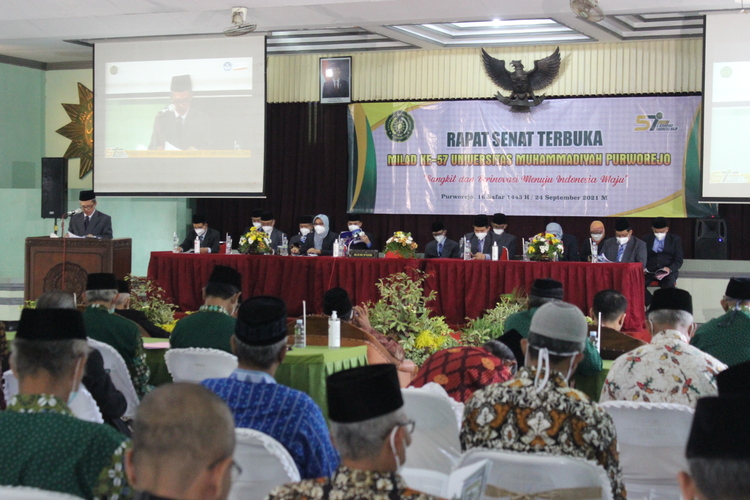
The guest lecture, held at the East Campus Seminar Room, was attended by approximately 160 participants, consisting of PTO and PGSD students, as well as teacher communities from Purworejo Regency. The event was also attended by the Head of the PTO Study Program, Dwi Jatmoko, M.Pd., the Head of the PGSD Study Program, Rintis Rizkia Pangestika, M.Pd., along with lecturers and administrative staff within UMPWR.
The organizing committee chair, Muhammad, a fourth-semester student representing the Automotive Student Association (HIMATO), expressed his hope in his opening remarks that the activity would provide new perspectives for both students and teachers in addressing educational challenges in the digital era.
Furthermore, the Head of the PTO Study Program, Dwi Jatmoko, M.Pd., in his remarks, expressed appreciation for the successful organization of the guest lecture and emphasized the crucial role of teachers in facing digital transformation, particularly in utilizing technology wisely and innovatively in the learning process.
As the main speaker, Muhammad Nur Rizal, S.T., M.Eng., Ph.D., Founder of the Gerakan Sekolah Menyenangkan (Fun School Movement), delivered material on innovative learning concepts relevant to current developments. In his presentation, he highlighted the use of technology, especially Artificial Intelligence (AI), as an adaptive and interactive learning medium capable of accommodating students’ learning needs in a more personalized way.
He explained that AI can be utilized by teachers in various aspects of learning, ranging from content development and evaluation to creating more contextual and engaging learning experiences. However, he emphasized that the role of teachers remains central as facilitators who guide the use of technology in line with educational values.
Through this activity, it is expected that participants will develop a more adaptive and innovative mindset in the learning process, enabling them to create a more creative and engaging learning environment amid the rapid advancement of digital technology. (Editor: Akb/KP).