Universitas Muhammadiyah Purworejo (UMPWR) organized the Baitul Arqam program for lecturers and education staff, attended by 56 participants, at Grand Kolopaking Hotel, Kebumen, from 28–30 January 2026. This program is part of UMPWR’s strategic efforts to strengthen the understanding and practice of Al-Islam and Kemuhammadiyahan (AIK) in campus life.
The Baitul Arqam program was officially opened by the Vice Rector II of UMPWR, Dr. Muhamad Taufik, M.T. In his opening remarks, he emphasized that the internalization of AIK values is a crucial foundation for lecturers and education staff in carrying out both their academic roles and institutional services. According to him, AIK should not only be understood conceptually but must also be reflected in attitudes, work ethics, and the daily culture of the campus.
“Baitul Arqam is not merely a ceremonial activity; it is a process of internalizing the values of Al-Islam and Kemuhammadiyahan so that lecturers and education staff develop ideological, spiritual, and professional awareness aligned with the vision of Universitas Muhammadiyah Purworejo,” he stated.
He further added that AIK values should become the spirit of all campus activities.
“When AIK truly lives within the academic community, a work culture that is trustworthy, disciplined, and progressive will naturally grow within the UMPWR environment,” he added.
Carrying the theme “Internalization of Al-Islam and Kemuhammadiyahan in Campus Life,” this Baitul Arqam program was designed to strengthen the ideology, spirituality, and Muhammadiyah commitment of the entire academic community. Through this program, it is expected that harmony will be created between the institution’s vision and its real practices in the implementation of higher education.
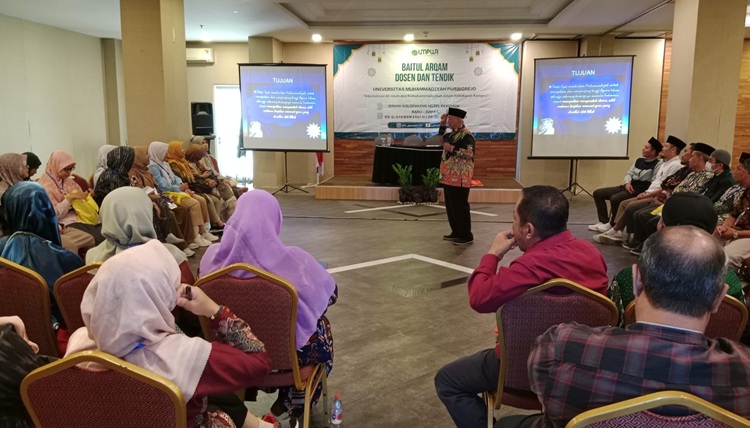
Meanwhile, the Head of LP3AK UMPWR, H. Nasrudin, M.Si., explained that Baitul Arqam is part of a structured and continuous development program.
“Through this Baitul Arqam, we want to ensure that AIK values do not stop at the level of understanding, but are implemented concretely in campus life, whether in learning, services, or daily interactions,” he explained.
According to Nasrudin, the materials delivered were systematically prepared to meet the needs of the academic community.
“All materials are tailored to the current challenges faced by Muhammadiyah higher education institutions, so that participants are expected to be able to formulate applicable follow-up action plans within their respective work units,” he concluded.
During the three-day program, participants received various materials, including the Guidelines for Islamic Life of Muhammadiyah Members (PHIWM), Work Ethics in Muhammadiyah Charitable Enterprises (AUM), Leadership Management and Competency Enhancement for UMPWR Lecturers and Education Staff, Internalization of AIK as Living Values and Integrative AIK, The Strategic Role of Cadre Development at UMPWR, Islamic Understanding According to Muhammadiyah, Worship Practices Based on the Majelis Tarjih, and an in-depth study of Muhammadiyah ideology.
This Baitul Arqam program is expected to serve as a sustainable development platform for lecturers and education staff at UMPWR in realizing a superior, character-based campus grounded in the values of progressive Islam.