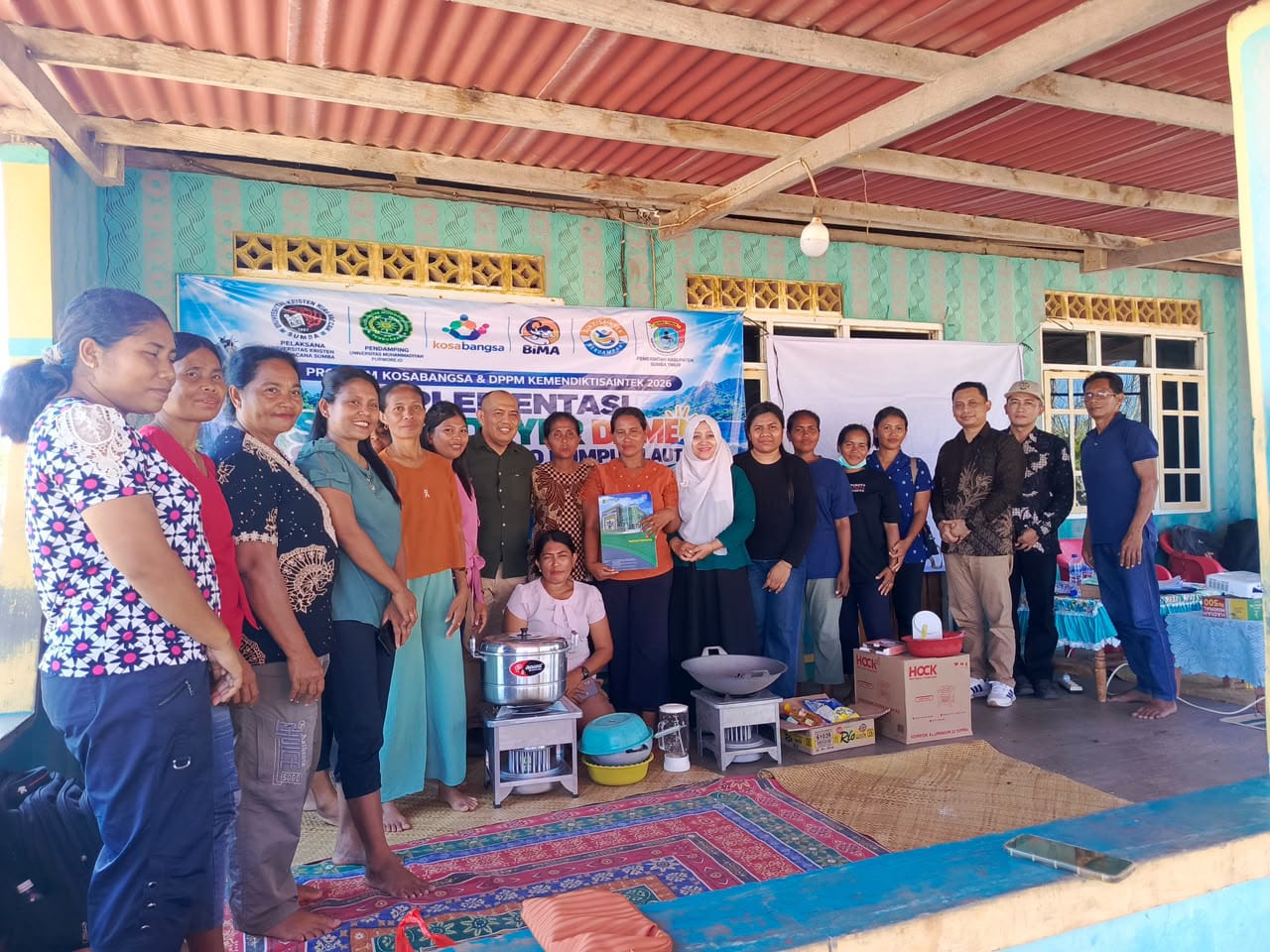
EAST SUMBA – Universitas Muhammadiyah Purworejo (UMPWR), in collaboration with Universitas Kristen Wira Wacana Sumba (Unkriswina Sumba), continues to strengthen its partnership in empowering coastal communities through the Community Development Social Collaboration Program (Kolaborasi Sosial Membangun Masyarakat or Kosabangsa). The program is funded by the Directorate of Research and Community Service (DPPM), under the Ministry of Higher Education, Science, and Technology (Kemendiktisaintek) for 2026. In addition to supporting the implementation of solar-powered seaweed drying technology through the Solar Dryer Dome (SDD), Kosabangsa also focuses on developing innovative seaweed-based food products, including seaweed meatballs and seaweed crackers, as part of efforts to diversify local food products with greater economic value and functional potential.
The program is led by Dr. Tumpal Pangihutan Situmorang, S.T., M.M., from Unkriswina Sumba, with team members Elsa Christin Saragih, S.P., M.P., and Yatris Rambu Tega, S.Pi., M.Si. As the partner university providing assistance, UMPWR contributes by strengthening food innovation and developing products based on local resources. The UMPWR support team is led by Prof. Dr. Suyitno, M.Pd., with members Dr. Jeki Wibawanti, S.Pt., M.Eng., M.Si., and Dr. Murry Harmawan Saputra, S.E., M.Sc.
This community service initiative, carried out in Kaliuda Village, Pahunga Lodu District, East Sumba Regency, East Nusa Tenggara, is part of the universities’ efforts to introduce technological innovations that can be directly applied and benefit local communities.
Seaweed is one of the leading commodities in coastal areas, with significant potential for development into a wide range of food products. However, its utilization can be further enhanced by processing it into more diverse and appealing ready-to-eat products with higher market value.
Through the Kosabangsa program, community members are introduced to innovative methods of processing seaweed into meatballs and crackers. These products were selected because they are widely familiar to consumers, have market potential, and can be developed as alternative food businesses based on local resources.
Seaweed meatballs are developed by incorporating seaweed as an additional ingredient in the meatball formulation. Seaweed contains dietary fiber and various minerals, as well as hydrocolloid components that may help improve product texture and water-holding capacity. With the right formulation, this innovation is expected to produce meatballs with good sensory qualities and greater added value compared with conventional products.
Meanwhile, seaweed crackers offer an alternative way to diversify processed marine products. Incorporating seaweed into cracker formulations is expected to produce an appealing snack while creating opportunities for home-based businesses and micro, small, and medium enterprises (MSMEs) in coastal communities.
The development of these two products is not solely focused on food innovation but also serves as a means of improving community knowledge and skills in processing local raw materials. Through training and mentoring, community members are encouraged to understand raw material selection, processing techniques, the implementation of hygiene and sanitation practices, and proper product packaging.
The collaboration also emphasizes the importance of integrating post-harvest technology with food processing. The introduction of Solar Dryer Dome technology is expected to support the availability of dried seaweed that is more hygienic and maintains better quality, making it suitable for further processing into food products.
Beyond technical production, the development of seaweed meatballs and crackers also offers prospects for strengthening entrepreneurial capacity within the community. Product diversification is expected to expand marketing opportunities and reduce dependence on selling seaweed in its raw form.
This innovation aligns with the concept of the blue economy, which promotes the productive and sustainable use of marine resources to support economic growth and improve the welfare of coastal communities.
Going forward, the development of seaweed meatballs and crackers is expected to continue through formulation improvements, food quality and safety testing, better packaging, and business mentoring tailored to the needs of community groups.
Through the 2026 Kosabangsa Program, the collaboration between UMPWR and Unkriswina Sumba is expected to strengthen community self-reliance in utilizing the potential of seaweed, not only as an aquaculture commodity but also as a raw material for value-added food innovations.