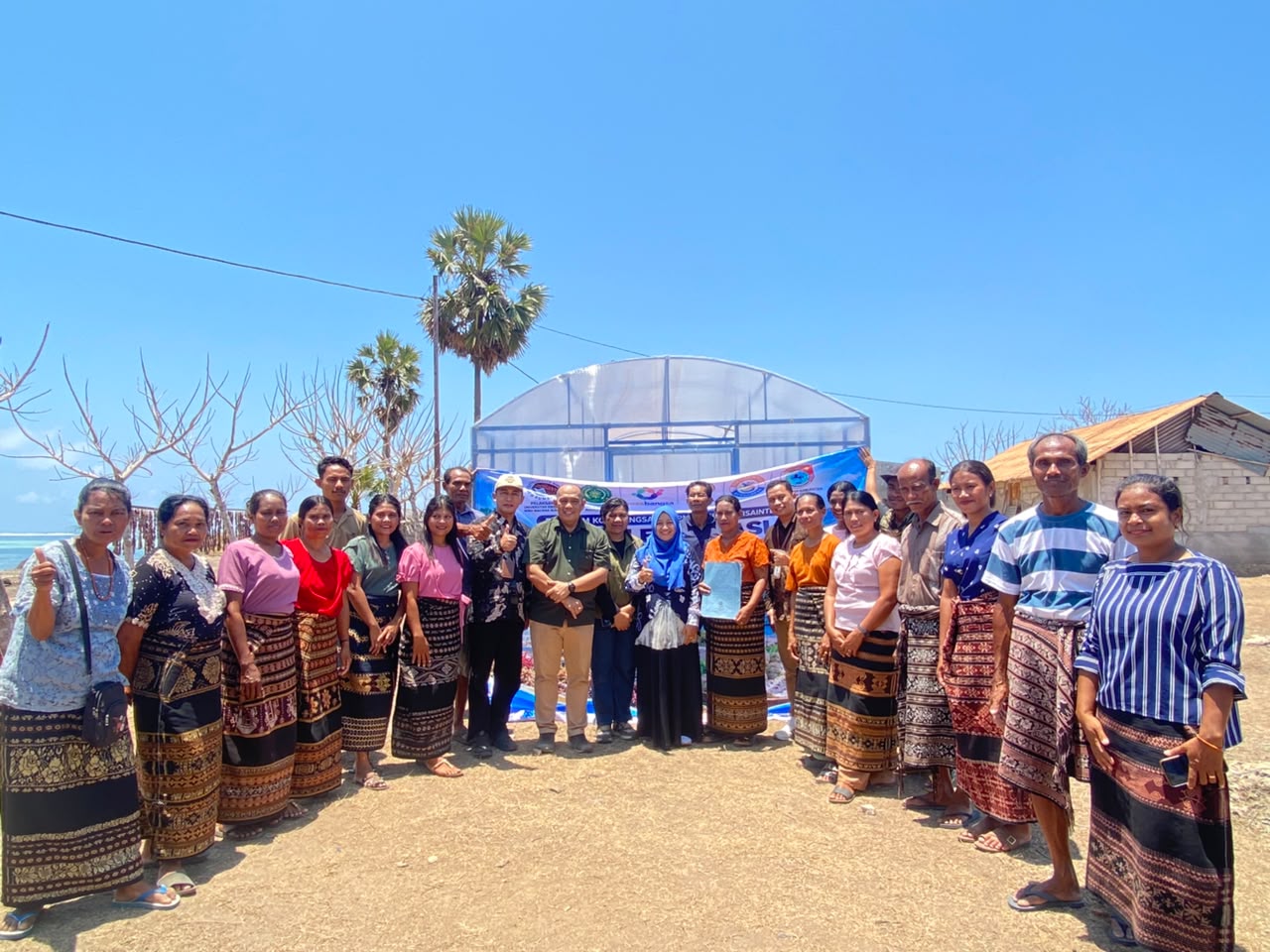
EAST SUMBA – Universitas Muhammadiyah Purworejo (UMPWR) continues to strengthen its contribution to community service through inter-university collaboration. Together with Wira Wacana Christian University of Sumba (Unkriswina Sumba), UMPWR is supporting the implementation of solar-powered seaweed drying technology to improve the quality of production and strengthen the economic potential of coastal communities in Kaliuda Village, Pahunga Lodu Subdistrict, East Sumba Regency, East Nusa Tenggara.
The event, held on Wednesday, October 21, 2026, was part of the 2026 Social Collaboration for Community Development (Kosabangsa) Program, funded by the Ministry of Higher Education, Science, and Technology (Kemendiktisaintek) through the Directorate of Research and Community Service (DPPM).
This program is themed “Implementation of Solar Energy Technology to Support the Blue Economy through Increased Productivity in Ikat Weaving and Seaweed Cultivation in the 3T Village of Kaliuda, East Sumba Regency.” One of the innovations implemented is the Solar Dryer Dome (SDD) technology, a drying system that utilizes solar energy to support the post-harvest processing of seaweed.
The implementation of this technology is aimed at the Kandora Jaya Dasa Wisma group, a productive community group engaged in seaweed cultivation in the Kandora area of Kaliuda Village.
Until now, the traditional method of drying seaweed in open areas has faced a number of challenges, particularly dependence on weather conditions and the risk of contamination during the drying process. Through the use of the Solar Dryer Dome, the drying process is expected to become more controlled, hygienic, and capable of improving the quality of seaweed products.
The program was led by Dr. Tumpal Pangihutan Situmorang, S.T., M.M., from Unkriswina Sumba, along with team members Elsa Christin Saragih, S.P., M.P., and Yatris Rambu Tega, S.Pi., M.Si.
Meanwhile, UMPWR served as the supporting university through a team led by Prof. Dr. Suyitno, M.Pd., with members Dr. Jeki Wibawanti, S.Pt., M.Eng., M.Si., and Dr. Murry Harmawan Saputra, S.E., M.Sc.
UMPWR’s involvement in this activity is aimed at strengthening the mentoring process, the application of appropriate technology, and community capacity building in utilizing innovations in line with local needs and resource potential.
In addition to introducing drying technology, this event also served as a platform for collaboration between academics and the community to identify challenges in seaweed processing and promote the use of technologies that can be applied sustainably.
The Kosabangsa program also involved five Unkriswina Sumba students from the Management, Fishery Products Technology, and Agribusiness programs. The students’ participation provided them with hands-on learning experiences through interaction with the community, while also strengthening the application of scientific knowledge in solving real-world problems.
The Kaliuda Village Government is supporting the implementation of a program deemed to align with the community’s needs to improve the quality of seaweed processing.
The chairperson of the Kandora Jaya Dasa Wisma, Yublina Heo, also expressed her appreciation for the introduction of the Solar Dryer Dome technology. This innovation is expected to assist group members in the drying process, improve the hygiene of their products, and provide economic benefits to the community.
This collaboration between UMPWR and Unkriswina Sumba reflects the strategic role of higher education institutions in providing science- and technology-based solutions, particularly for communities in underdeveloped, frontier, and outermost regions (3T).
Furthermore, the application of renewable energy technology in seaweed processing is expected to serve as a first step toward strengthening the blue economy through the productive and sustainable use of coastal resources.
Through collaboration among universities, the village government, and community groups, the Kosabangsa 2026 Program is expected not only to facilitate the implementation of appropriate technology but also to promote skills development, entrepreneurial independence, and the well-being of the community in Kaliuda Village.