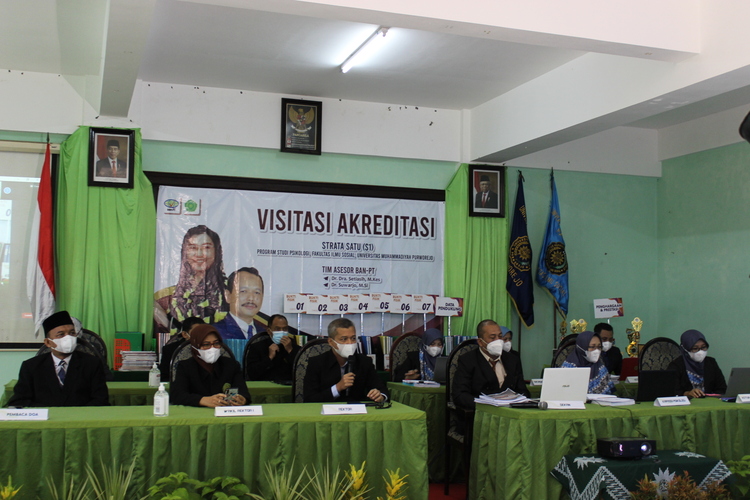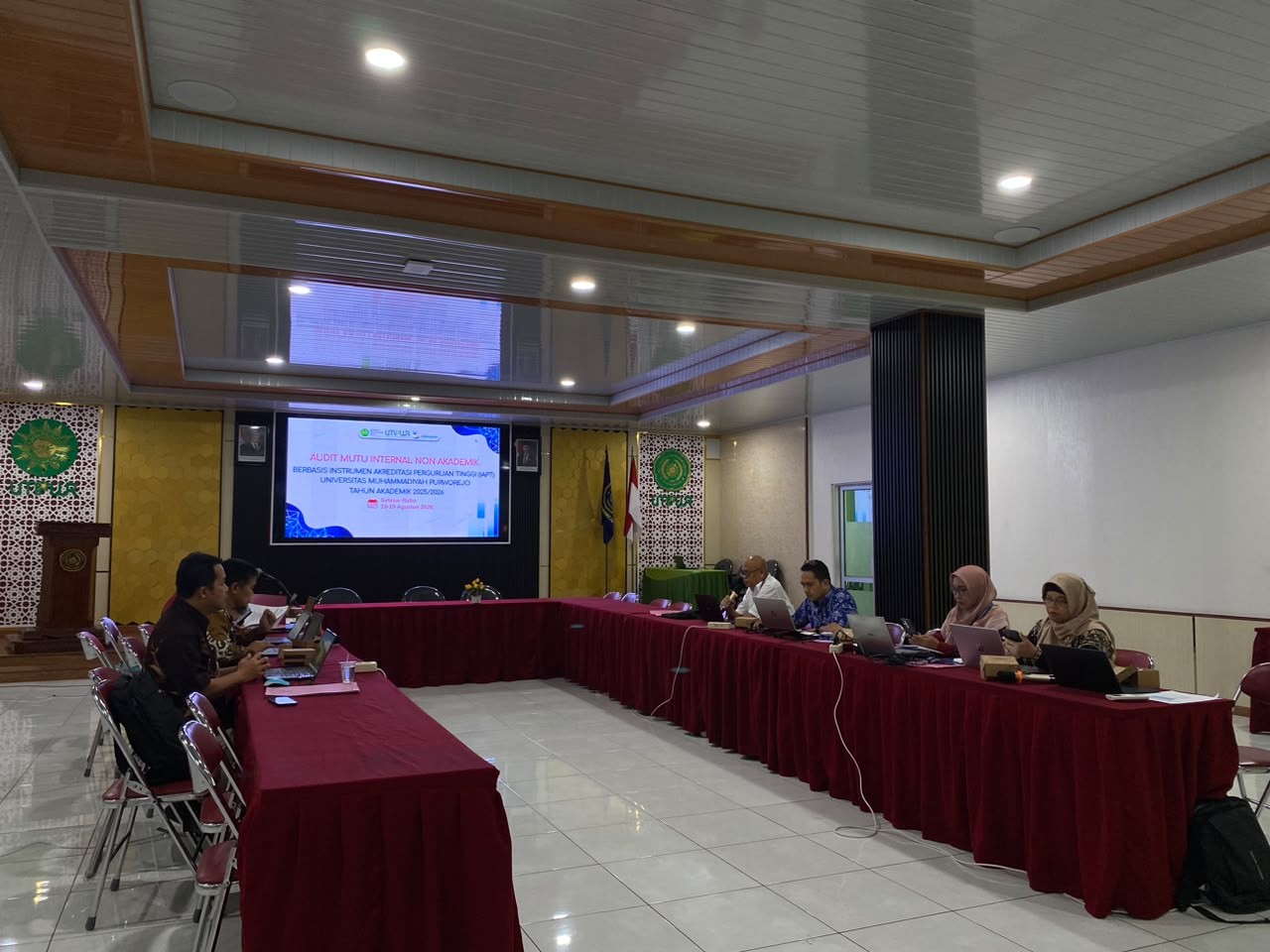
Universitas Muhammadiyah Purworejo (UMPWR) – Efforts to maintain and improve quality do not stop at academic processes. After completing the Academic Internal Quality Audit (AMI) on August 11–12, 2026, Universitas Muhammadiyah Purworejo (UMPWR) continued its quality assurance efforts by conducting a Non-Academic Internal Quality Audit (AMI) on Tuesday–Wednesday, August 18–19, 2026.
Organized through the Quality Assurance Institute (LPM) of UMPWR, the activity is part of a series of internal evaluations aimed at assessing the extent to which governance and non-academic services across various units are being implemented in accordance with the standards established by the university.
The Non-Academic AMI is not merely an administrative inspection. More importantly, the audit provides an opportunity to review the implementation of programs, identify areas that still need improvement, and ensure that every unit continues to work within the same quality culture.
Based on the Non-Academic AMI schedule, the audit covers university leaders and a number of related units. On the first day, Tuesday (August 18, 2026), the audit involves the Rector and Vice Rectors I, II, III, and IV, followed by audits of units under the coordination of Vice Rector IV and Vice Rector III.
On Wednesday (August 19, 2026), the audit continues with units under the coordination of Vice Rector I and Vice Rector II. The units involved in the audit include LPM, LPPM, the Language Institute, PPJPU, the Education Development Unit (UP2), the Bureau of Academic Administration, the University Library, the Bureau of General Administration, PPTIK, the Finance Bureau, as well as all heads of laboratories.
The audit is conducted by an appointed internal audit team, with team leaders and auditors assigned to each group of auditees. The process is expected to provide a more comprehensive picture of how governance is being implemented across the university.
UMPWR Rector Assoc. Prof. Dr. Teguh Wibowo, M.Pd., said that quality improvement must be carried out comprehensively. According to him, the quality of a higher education institution is determined not only by the learning process and academic achievements, but also by how its entire supporting system is managed.
“University quality is not built only in classrooms and through the learning process. Governance, services, administration, resource management, and student services are also important parts of quality. Therefore, we see this Non-Academic AMI as an effort to identify what has been working well and what still needs to be improved,” he said.
He added that the results of the audit should not stop at being recorded in evaluation documents. Any findings need to be followed up by each respective unit so that they can contribute directly to improving the quality of university services.
“We hope that all units will be open throughout the audit process. An audit should not be seen as something to be feared. Instead, through an audit, we can understand where we currently stand and then work together to make continuous improvements,” the Rector added.
Meanwhile, Head of LPM UMPWR Prof. Dr. Suyitno, M.Pd., explained that AMI is an important instrument for ensuring that the university’s internal quality assurance system is functioning properly. While the previous Academic AMI focused primarily on aspects related to academic implementation, the Non-Academic AMI places greater attention on governance and supporting services.
“AMI is not simply about looking for mistakes or shortcomings within a unit. What matters most is assessing the alignment between standards, implementation, and the available evidence. If there are areas that do not yet meet the standards, they become a basis for us to improve together,” he explained.
Prof. Suyitno hopes that regular audits will help establish a culture of evaluation within every unit. In this way, quality culture will not be the sole responsibility of LPM but will become an integral part of the way all members of the university community and work units at UMPWR carry out their responsibilities.
The implementation of the Non-Academic AMI continues the series of internal quality assurance activities previously conducted through the Academic AMI on August 11–12, 2026. The two processes complement each other as part of UMPWR’s efforts to ensure that university governance is implemented consistently, measurably, and with continuous improvement.
Through the ongoing implementation of AMI, UMPWR reaffirms its commitment to building a quality culture that goes beyond merely meeting standards. It also encourages every unit to continuously improve and provide the best possible services for students and all stakeholders. (akb/KP)