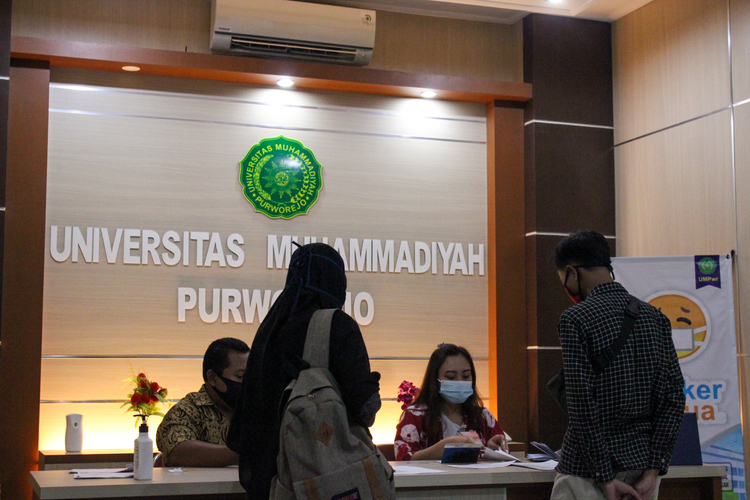
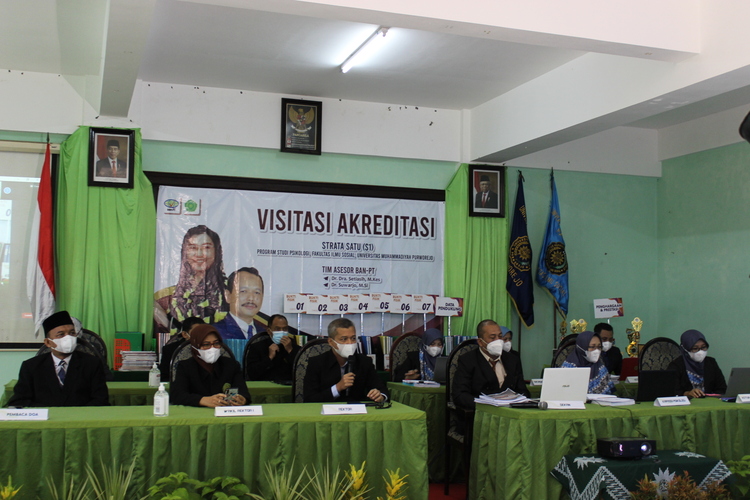
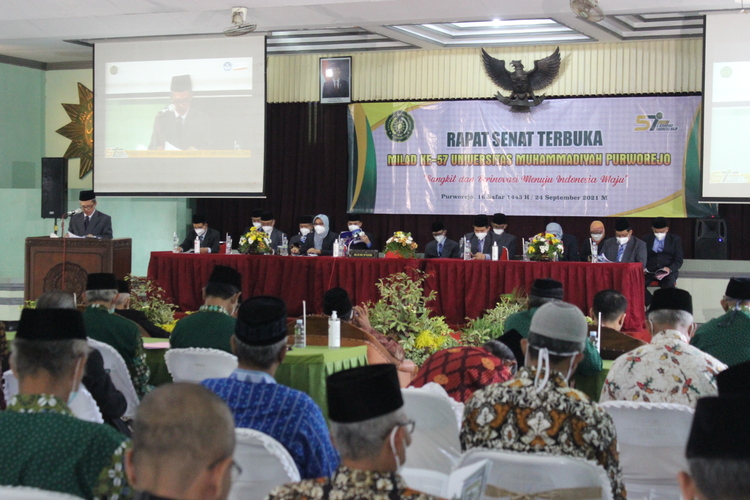
Universitas Muhammadiyah Purworejo (UMPWR) held its monthly Al-Islam and Muhammadiyah Studies on Friday (August 7, 2026) at the Seminar Hall of the East Campus. The session, attended by faculty members and administrative staff, featured Ust. Fajar Rachmadhani, Lc., M.Hum., Ph.D., a member of the Majelis Tabligh of the Central Board of Muhammadiyah, as the keynote speaker.
In his lecture, Ust. Fajar addressed two important issues that are highly relevant in today's society: the danger of mujahir (publicly exposing or boasting about one's sins) and the importance of sincerity (ikhlas) in performing good deeds.
He explained that one of the concerning trends in the digital era is the growing tendency for some people to openly display sinful behavior. Acts of disobedience are often shared on social media, turned into entertainment, or even treated as a source of pride in pursuit of attention and public recognition.
The Prophet Muhammad (peace be upon him) gave a strong warning against such behavior:
"All of my followers will be forgiven except those who publicize their sins. Among those who publicize their sins is a person who commits a sinful act during the night, which Allah has concealed, but in the morning he says, 'O so-and-so, I did such-and-such last night,' even though Allah had concealed it for him, yet he removes Allah's covering from himself."
(Sahih al-Bukhari, No. 6069; Sahih Muslim, No. 2990).
According to Ust. Fajar, this hadith reminds Muslims to maintain a sense of modesty and humility when they fall into sin. If a person commits a wrongdoing, the proper response is to sincerely repent and strive for self-improvement, rather than publicizing or glorifying the mistake.
In addition to discussing mujahir, he emphasized that every good deed must be performed solely for the sake of Allah. A righteous person should not expect universal praise, because criticism, misunderstanding, and even hostility are inevitable.
He reminded the audience that no one can please everyone. Even Prophet Muhammad (peace be upon him), the most honorable and beloved servant of Allah, faced rejection, insults, and opposition throughout his mission. Therefore, Muslims should never allow public opinion to determine their commitment to doing good.
"If even the Messenger of Allah had people who hated and opposed him, then we—who are far from perfect—should not be surprised when others dislike us. What truly matters is that our intentions remain sincere and that every deed is performed solely for the pleasure of Allah," he said.
His message echoed the well-known hadith:
"Actions are judged by intentions, and every person will receive according to what they intended."
(Sahih al-Bukhari, No. 1; Sahih Muslim, No. 1907).
He also referred to the Qur'an, where Allah says:
"They were commanded only to worship Allah, devoting their religion sincerely to Him in true faith."
(Qur'an, Surah Al-Bayyinah [98]: 5).
Through this monthly Islamic study, UMPWR continues to strengthen the implementation of Al-Islam and Muhammadiyah values across the university community. The program serves not only as a platform for deepening religious understanding but also as a reminder for all members of the academic community to uphold sincerity in every good deed, avoid the practice of mujahir, and seek Allah's pleasure above all else in both personal and professional life.